
An informative failure
29 Sep 2026
Seven years ago I committed to cut our family’s carbon footprint in half by 2026. We failed but learned a lot along the way about effective climate action.
In May 2019, I committed to reducing our family’s carbon footprint by 50% over seven years. Time flies and now’s the time for a reckoning. How do we do and what did I learn?
Predictably, we failed. But I learned a lot along the way. This blog reflects on those seven years, where we succeeded and failed, how my thinking evolved, and where I’ve ended up with my personal contribution to climate action.
Scores on the doors
I’m not going to revisit all the numbers in detail, but the make up of the 50% target reduction were roughly as follows, together with the assessed outcome after seven years scored from 0 (no progress) to 10 (completed in full):
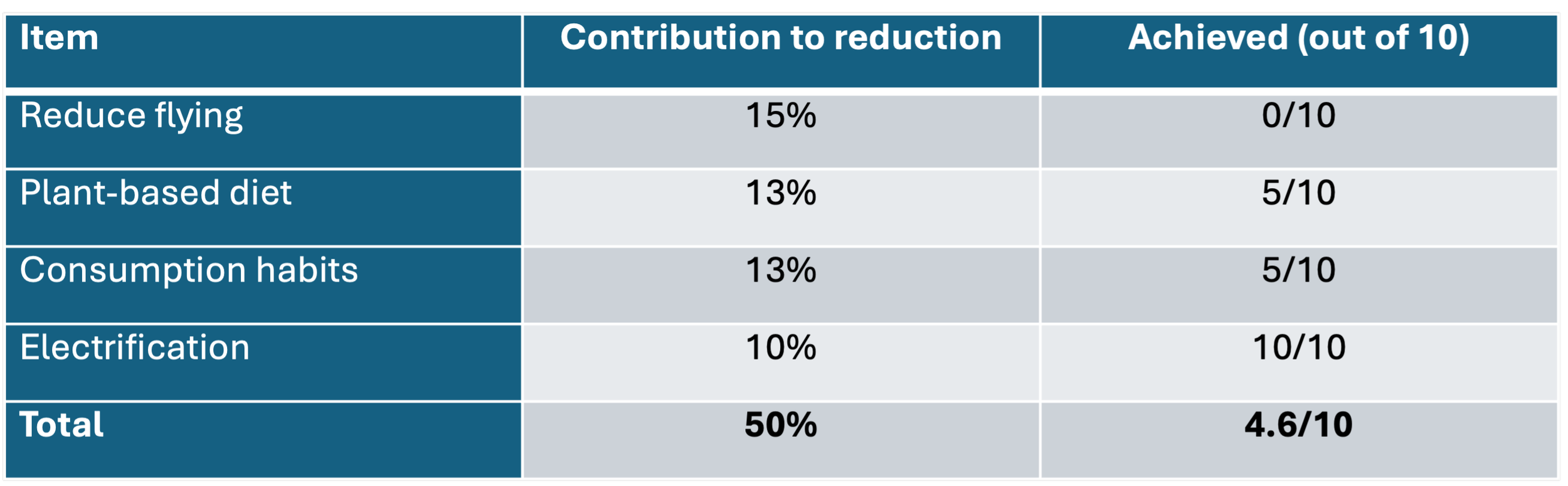
We achieved a 23% overall reduction, less than half what we’d pledged. (Remind me never to criticise and investor or issuer for missing their target!) So what went wrong and what went right?
Flying
The aim was to move to a rolling three-year average of 1 Tonne per head of emissions from flying, roughly equivalent to two return trips to southern Europe per year.
In practice we got nowhere near that. My eldest daughter did a 15-month working holiday in Australia and travelling around Asia and my wife and I both went to see her. That blew several years of our allowance straight away. This highlighted an immediate dilemma. We weren’t prepared to restrict our daughter’s life experiences for our (or, more accurately, my) carbon target and once she was out there, of course we went to see her given we were able. Climate commitments are all very well until they butt up against what you really want to do.
At the same time returning to work at the London School of Economics and Political Science has brought with it travel for conferences, often, ironically, to talk about climate action! (Although there is a debate about whether work emissions should appear in my personal footprint in any case.) Finally, my wife and I like travel and are enjoying the chance to do more of it now the children are grown up.
Diet
Here we have made genuine changes. We now eat much more vegetarian food as a family, although my wife and I have gone more vegetarian than our children. Overall, this has been a life-enhancing change: we like it and feel better for it. My wife is the house chef and has developed a fantastic array of tasty plant-rich specialities. It’s a joy.
Consumption
The reduction here comes entirely from the 20% underlying decarbonisation of the economy which I assumed, and which feeds into all consumption. Our levels of, and choices of, consumption have not changed much. Although our lifestyle is not excessive for people in our position, we still live a high-consumption lifestyle by any global measure and are probably too selfish to give it up.
Electrification
This is the one unalloyed success of the project (and likely would not have happened without the pledge). We now burn no fossil fuels directly in our home other than the odd candle and occasional barbecue. We’ve moved to a heat pump, induction hob, solar plus battery, and electric vehicles. This has been fantastic and although requiring a significant upfront investment has halved our total fuel bills.
Lessons learned
So what have I learned from seven years of trying to meet a rash climate pledge?
1. You can’t make decisions for other people
Launching a commitment to halve my family’s footprint was probably something I should have talked to them about beforehand. Some aspects, such as electrification, are largely in my control. Most are largely not. I was not going to set myself up as my family’s carbon monitor. Really, I should’ve had a more consultative process about what we’d do and where we’d focus. My wife and I are agreed on trying to eat more vegetarian food and to some extent we can influence our children’s choices, but they are adults themselves. Similarly, my wife and I like the thought of train trips around Europe as we enter a phase of life where we have more time, whereas for my children squeezing a holiday into a limited schedule of work leave, flying is a godsend. Everyone is aligned on electrification (my wife loves the heat pump and electric car).
2. A high carbon lifestyle is enjoyable
The best things in life come free, but the things you have to pay for are pretty good too. And most things you pay for come with a carbon bill. Quite a lot of what we spend money on is not so carbon intensive: eating out, weekends away. But other bits are: flying, new bikes, a new kitchen, a new car. My own passion for cycling will result in three trips to Europe in 2027 alone. The truth is we’ve not really reduced what we spend and that drives a lot of the carbon footprint.
3. Carbon footprints are a flawed construct, we need to focus on system solutions
Having missed the target, this sounds very convenient, but it’s also true. While I have some instinctive sympathy for degrowth thinking (perhaps it’s my Catholic upbringing), we’re unlikely to shrink our consumption to meet sustainable levels of carbon emissions. We have to find ways to put that consumption on a cleaner footing, through the energy transition, innovation of industrial and agricultural processes, and carbon pricing. We need a system solution to a system problem. Indeed, carbon footprints (allegedly invented by the oil major BP) are often criticised for misallocating responsibility for emissions to the consumer. We need to focus on shifting the system issues and developing both the politics and the technology to enable decarbonisation. Although consumers don’t get completely off the hook: they need to play their part too as there is nothing a business responds to like a consumer.
Revisiting my approach to personal climate action
So how have these lessons-learned affected my approach to personal climate action?
Bye-bye carbon footprint
I have given up mechanical calculation of my carbon footprint. It’s complicated and subject to huge uncertainty. Large parts of it are outside my control. Also, I’m simply not going to shrink my way to a lower footprint by denying myself life’s pleasures in a puritanical way: after all, the title of my first article on the topic seven years ago was: A middle-class approach to decarbonisation.
Instead, a few years ago I decided to focus on a few areas where I am best equipped to make a contribution. These are:
Electrification
Politics
Advocacy
Electrification
There is no pathway to decarbonisation that does not involve substantial electrification of the economy. Electrification also holds out the genuine future hope for affordable, secure energy, cleaner air, and much enhanced energy, home comfort, and transport services - although there are plenty of challenges and difficulties between here and there.
Indeed, mass electrification is essential to unlock the promise for renewables-based systems to be cheaper rather than more expensive: as Michael Liebreich has pointed out, we need to spread the fixed costs of the build-out of grid and renewables across more kWh of electricity.
Electrification needs early adopters, prepared to experiment with new technologies and nascent markets, and to act as advocates and examples to their neighbours. Such early adopters are a critical part of demonstrating viability, building momentum, and creating political and societal support for change. Many electrified technologies are inherently superior to their fossil counterparts but require changes in habits: dealing with electric chargers rather than filling your car; using time-of-use tariffs with batteries to slash average electricity prices; heating slow and low with a weather-compensated heat pump rather than the on-off thermostat of a gas boiler. Electrification may also need upfront expenditure as markets scale or may require patience to deal with the growing pains of developing technologies, products and services, and supply chains.
I’ve decided to make home electrification a priority as I’m interested in it, love the technology aspect and have the resources to take the risk of being an early adopter. I’ve written about my electrifying journey elsewhere and how solar, battery and heat-pump have halved our fuel bills. We’ve now moved entirely to electric cars. I’m participating in a variety of emerging technologies and services:
virtual power plants (thousands of home batteries that can be co-ordinated to discharge into the grid to relieve local stresses, essential to dealing with the variability of renewables);
vehicle to grid (using your car battery as a battery to charge your home);
load flexibility (shifting electric car charging or other loads like water heating to lower carbon periods on the grid).
Electrification is an area where I can be part of a community of consumers enabling new products and services to evolve. It also gives my son and me and excuse to play around with a Raspberry PI, Home Assistant, and hacking into our heat pump.
Politics
I’m not a politician. My friend and collaborator Harald Walkate has put his words into action by successfully standing for election in Amsterdam. I admire him but am unlikely to follow him down that path. However, I will not vote for any party that doesn’t have a credible climate policy. Where Harald puts his words into action I put my money where my mouth is and financially support good local candidates who are sound on climate. I engage with my representative where I have a relevant voice, as, for example, when I wrote to my MP on heat pump planning laws, triggering two parliamentary questions (there was a subsequent relaxation of planning laws: correlation not causation!). Politicians won’t care about climate unless we tell them we do.
Advocacy
Part of my pledge back in 2019 was to communicate about my climate action, which I’ve done with this and over a dozen previous blogs, articles, and podcasts over the last seven years. I’ve tried to be honest about my (less frequent) successes and (more frequent) failures. I’ve tried to be flexible and change my mind when the facts, or my understanding of the facts, changes. I’ve tried to take a pragmatic approach, focusing on solutions that could work at a system level. Through my job I am able to be an advocate for what I authentically believe to be credible investor action on climate change, even if not everyone agrees with my views. Continuing to talk about the importance of climate change, about how we see it, and about what we’re doing about it is a critical part of influencing the political and societal context for climate action and the business analysis of consumer preferences.
What about investments?
Given I’m Director of an Initiative in Sustainable Finance it’s maybe a surprise I’ve said relatively little about my personal investments. I do think the finance industry has an important role to play, and that consumers can send useful signals about their preferences through the way they invest. I just don’t think that most consumers, including me, are that well equipped to drive significant climate action through their investments, which tend to be heavily focused in secondary markets. And there is a big risk of consumers adopting strategies that expose themselves to risk while achieving little in terms of climate action. I wasn’t sorry to see the demise of the misguided Make My Money Matter campaign, which gave the false impression that reducing your financed emissions through banking and investment choices was the most important thing a consumer could do.
But finance does matter, so what have I concluded about my investments?
First of all, I don’t do anything that could compromise my core financial objectives. I just don’t think the types of investment I have will make that much difference to climate change even in a best case, so I won’t compromise my core strategy. This means I identified an investment approach that I believe in and then looked for the best asset manager to implement that approach.
Secondly, having done that, I do then choose the manager’s sustainable fund options where available. In my case these have a climate-oriented engagement and voting strategy and a tilting strategy within sector towards better climate performers. This fits with my objectives of sending a signal, aligning with my values, and perhaps having a modest impact (although I’m under no illusions about how modest that likely is). So 85% of my investments (outside direct gilt holdings) are in sustainable funds of some form. This is more as a signal of intent than in expectation of impact – I’m exposing myself to a little tracking error, but frankly not much.
Thirdly, and finally, I have joined a climate impact investing syndicate. Providing growth capital to climate tech firms is an area where I can use my capacity for risk to make a difference. Such firms are capital constrained – particularly now in an era when AI is sucking in all the funding – and so putting capital to work specifically in that sector is likely to make a small difference to what can get funded. I plan to increase such investments to a modest 5% of my portfolio over the next few years as investment opportunities emerge.
Self-taxation
After all this I still have a large carbon footprint. I’ve considered offsets but I’m sceptical. The whole idea that we can emit over here in exchange for paying for a project over there creates perverse incentives for low-quality offsets at minimum cost which have undermined the integrity of carbon markets. I also think in practice that’s the idea of offsets has the wrong psychological impact, creating the sense we can pollute with impunity.
However, self-taxation is a worthwhile concept. After all, any system-level solution to climate change must involve some level of carbon tax. So why not act as if such a tax exists? I adopt this logic by applying a tax of £100 per Tonne to my family’s carbon footprint. I don’t calculate this precisely – instead I start with my initial estimate of a few years ago and reduce it for tangible changes I have made (for example electrification). Because I feel so conflicted about all my air travel I apply a supertax of £1,000 per tonne above our target of 1 Tonne per family member per year on a rolling average basis. This has the effect of turning an economy flight into a business class fare for these excess flights. This does make me think about taking the train instead! In this way I’m mimicking the effects of a policy that could be considered a reasonable way of dealing with people with a high amount of emissions.
Then each year, I put the proceeds towards high-quality nature and biodiversity projects that I feel I understand reasonably well and are credible. This is not an offset, but it’s a contribution to restoration of nature that is proportional to the damage I’m causing. I have also thought of treating it truly as a tax and refunding the Treasury. Somehow I feel more confident in my nature projects.
Is it enough?
Despite my efforts I’m a major contributor to climate change with a personal footprint that must be in the top 1% globally. Despite saying I care about the issue I remain a big part of the problem. The path of my life is indeed strewn with hypocrisy. And for sure I want to imply no virtue here. As well as caring about climate change, I’m intellectually interested in the topic and its solutions, so climate action is a hobby not a sacrifice. Indeed, I haven’t made any significant sacrifices to my lifestyle through the actions I’ve taken. My brand-new Nissan Leaf electric car is the coolest piece of kit in my life right now.
But I have made an authentic effort to pay attention to the issue. The process of trying to meet the pledge has changed my thinking and areas of focus and for that I’m glad I took it. I’ve tried to reorient my actions towards system solutions where I can make a difference. For despite the moral case, collective self-sacrifice will not be the solution to climate change (although it may need to play at least a small role). On electrification, I’ve made genuine progress. Finally, I’ve kept my commitment to talk about what I’m doing.
So that’s the report card, warts and all, seven years after I took my climate pledge.
Will this be enough for my maker, or indeed for my children? I’m not sure. But it’s what I’ve decided to do, and seven years after my initial commitment, I’m at peace with it.




Seven years ago I committed to cut our family’s carbon footprint in half by 2026. We failed but learned a lot along the way about effective climate action.